
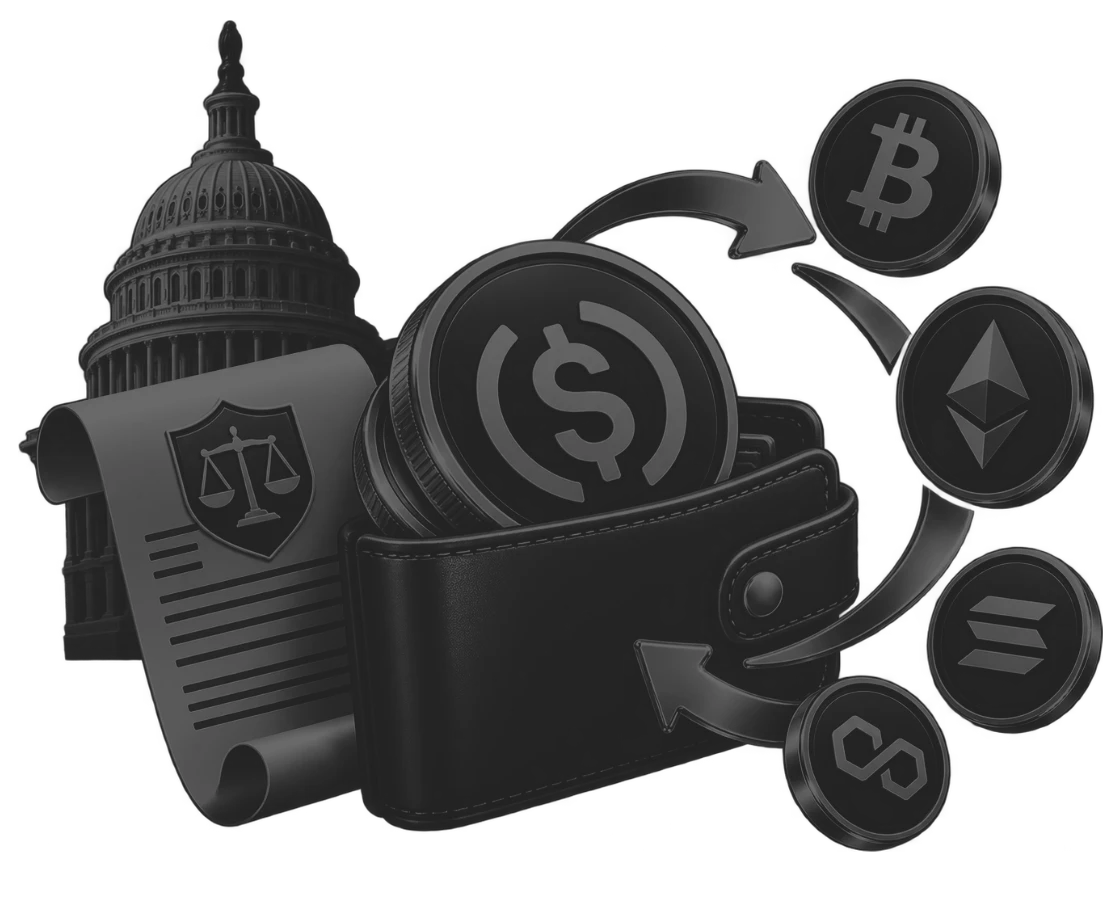
Stablecoins in Sparkling, Digital Dollars You Hold Yourself
For most US crypto users the dollar never really leaves: profits are parked in USDC, trades start from it, and moving it between chains is routine. Since the GENIUS Act, those digital dollars also have a federal rulebook. In Sparkling they sit in your own wallet and turn into any supported coin with one request.
How Do Stablecoins Work?
Behind each fiat-backed token sits a dollar’s worth of reserves at the issuer. Large customers can hand tokens back and receive dollars, so whenever the token trades under a dollar, arbitrageurs buy it cheaply and redeem it at par, and the price returns to its peg.
| Type | Backing | Example |
|---|---|---|
| Fiat-backed | Cash and short-term government debt | USDC, USDT |
| Crypto-backed | Over-collateralised crypto in smart contracts | DAI |
| Algorithmic | Supply rules, little or no reserve | Several have collapsed |
What the GENIUS Act Means for US Users
The GENIUS Act, signed on 18 July 2025, is the first federal framework for payment stablecoins. It takes effect on the earlier of 18 January 2027 or 120 days after regulators publish final rules.
- Only permitted issuers may offer payment stablecoins to people in the US.
- Reserves must back tokens one to one with cash, deposits or short-term Treasuries.
- Issuers must publish the composition of their reserves every month.
- Issuers may not pay interest to holders.
- A payment stablecoin is not a deposit and is not FDIC-insured.
Holding and Using Stablecoins in Sparkling
USDC can sit in your Sparkling wallet on Solana, Ethereum or TON. From there the agent turns it into BTC, ETH, SOL or TON, moves it between networks or swaps it into USDT, each on one card that shows the rate and fees.
| You ask | What happens |
|---|---|
| “Swap 300 USDC to ETH” | USDC becomes ETH on Ethereum |
| “Move 500 USDC from Ethereum to Solana” | The same dollars on a cheaper network |
| “Sell my SOL to USDC” | A position closed back into dollars |
Most people get their first USDC on a US exchange and send it in, the same route described when you buy crypto in the US with Sparkling.
Stablecoins and Your Taxes
For federal tax purposes a stablecoin is property, not cash. Swapping it for another coin, or even for a different stablecoin, is a disposal, though the gain or loss is usually small because the price barely moves. Keep the dollar values in your records like any other trade.
Are Stablecoins Safe?
Their safety rests on the issuer and its reserves. USDC itself slipped well under its peg for a weekend in March 2023, when Silicon Valley Bank, which held part of its cash, collapsed, and it recovered once the deposits were secured. Issuers are also able to freeze tokens tied to illegal activity. Sparkling crypto keeps your stablecoins in your own wallet and pays no interest on them; nothing here is financial advice.
Stablecoin Questions
What are stablecoins?
Tokens built to hold a steady value, usually one US dollar.
How do I buy stablecoins?
Buy USDC on a US exchange and send it to your wallet, or swap another coin into USDC in Sparkling.
Is USDC the same as a bank account?
No. It isn’t a deposit and has no FDIC insurance.
Does the GENIUS Act apply already?
It takes effect by 18 January 2027 at the latest, or earlier once final rules are out.
Can I earn interest on stablecoins in Sparkling?
No. Issuers covered by the GENIUS Act may not pay interest, and we don’t either.
Updated: